
Why street-level chargers change the logistics game
Urban deliveries used to rely on predictable depot cycles; now they also need flexible street-level energy. Retail chargers—especially compact models like a dual port EV charger—turn curbside parking into operational buffer. That buffer matters because drivers can top up between stops, reducing range anxiety and allowing fleets to run longer, more efficient routes. Expect smart charging and basic load management to be part of that shift; they let a single power feed serve multiple vehicles without blowing circuits.

What future cities are already proving
Cities with low-emission zones have forced a rethink: London’s expansion of its low-emission rules nudged fleets to consider electrified routes, and pilots in Amsterdam showed curbside chargers can cut deadhead miles. Those real-world anchors demonstrate one simple point—access to public power changes routing choices. Hardware that supports power sharing and clear tariff signals makes small charging stops practical for delivery vans and light commercial vehicles.
Design patterns that actually work for logistics
Successful installations follow three practical patterns: distribute many lower-power AC chargers near high-demand retail nodes; concentrate a few high-throughput points at micro-hubs; and integrate a software layer for reservation and queueing. The first pattern prioritizes port density and convenience; the second supports fast turnarounds near consolidation centers; the third prevents conflicts and manages peak load. Fleet managers comfortable with modest charge rates—and with predictable charging windows—often prefer multiple shared ports to a single fast charger.
Operational pitfalls and fixes
Deployment has common mistakes: oversizing power per stall, ignoring billing complexity, and underestimating space for queuing. Fixes are straightforward. Start with accurate demand mapping and schedule-based access, add smart charging to avoid simultaneous peaks, and standardize connectors so drivers don’t waste time swapping adaptors. Consider a mixed fleet strategy that blends depot charging with curbside stops—this reduces dependency on any single site and helps with charging tariffs and grid constraints.
Choosing the right station and metrics
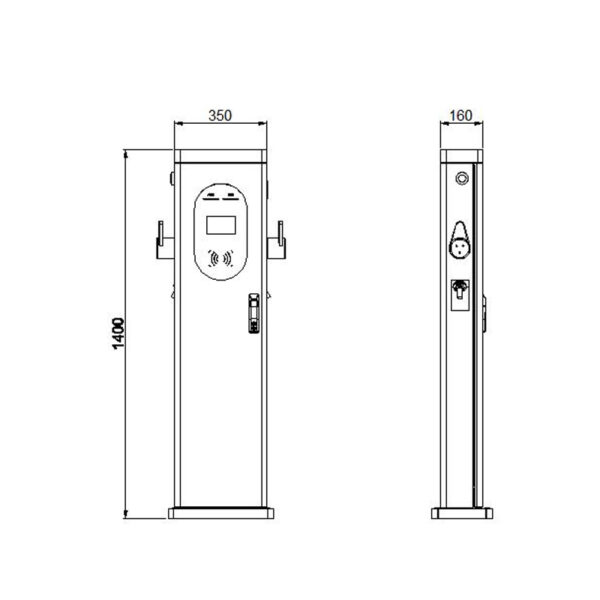
Hardware choice determines long-term utility. A robust option is a dual port EV charging station that supports two vehicles at once; it increases uptime per physical footprint and improves return on curb real estate. Look for reliable load management, clear metering, and software APIs for fleet dashboards. Key technical terms to have on your procurement checklist are AC charger compatibility, power sharing capability, and predictable charging tariffs.
Implementation checklist for operators
Use this compact checklist when piloting curbside charging:
- Demand survey: map delivery stops and idle windows.
- Power plan: confirm local grid capacity and set up load management.
- Access rules: define reservation windows and pricing tiers.
- Hardware: opt for dual-port units with modular firmware updates.
- Data integration: tie charging logs into routing and maintenance systems.
Three golden rules for scalable deployment
1) Measure utilization, not just installed count—if ports sit unused during peak delivery hours, change locations. 2) Prioritize interoperability—standard connectors and open APIs reduce headaches and speed adoption. 3) Balance power and patience: many short top-ups on distributed AC points beat a few contested DC ramps for urban deliveries.
Closing thought
Retail charging is practical insurance for city logistics: it smooths operations, reduces idle miles, and turns street parking into a strategic asset. Implement it carefully—follow the metrics above and choose solutions that scale. INFORE ENVIRO. –