Introduction — a focused problem-drivencase
Production lines that rely on manual edge banding commonly face inconsistent joint quality, variable cycle times, and unexpected downtime. A local investment in servo-driven edge banding addresses those precise failures by stabilizing feed rate, reducing rework, and shortening changeover time. Early adopters pair such installations with existing panel cutting lines—often a cnc panel saw—to retain throughput while improving finish quality.

Identifying the Core Operational Deficit
Manufacturers typically see three recurring symptoms: uneven glue application, mismatched edge profiles, and throughput that falls short of demand. These are not separate issues but linked shortcomings in process control. Edge banding driven by a reliable servo motor solves positional accuracy; consistent glue delivery and calibrated pressure rollers address adhesion and finish. The problem-driven approach demands we treat each symptom as evidence of where control is weak.

Tactical Implementation Steps
Begin with a narrow pilot: integrate a servo edge-bander at one cell, instrument the station for cycle time and defect logging, and run mixed batches. Integrate the unit control with plant-level PLC to maintain coordinated feed and stop signals with the downstream cnc panel saw machine. Measure trim cycle, adhesive temperature, and joint strength over at least 500 parts to produce statistically meaningful baselines. This phased path minimizes disruption to existing lines and produces actionable data quickly.
Operational Teardown — what we examined
In a recent production teardown we examined conveyor alignment, adhesive reservoir dynamics, and servo response. We examined {main_keyword} alongside {variation_keyword} during push-off tests and documented variance in lateral alignment less than 0.3 mm after servo calibration. The teardown emphasized mechanical checks: bearing preload, glue pot viscosity control, and correct trim blade angles. Real-world anchor: during the COVID-19 period many European shops in North Rhine-Westphalia shifted to local automation precisely to avoid bottlenecks caused by labor shortages; those cases showed that modest automation investments preserved delivery windows and market share.
Common Mistakes and Practical Alternatives
Teams often over-spec the unit capacity — buying a multi-head line where a compact servo edgebander suffices — or they under-invest in training. Both errors cost more than the machine itself. Alternatives include modular retrofits to existing edgebanders or outsourcing intermittent high-volume runs to local contract shops. A short, candid lesson: calibration matters more than horsepower. — Take time to match glue type to board core and to program trim cycles precisely.
Implementation Pitfalls to Avoid
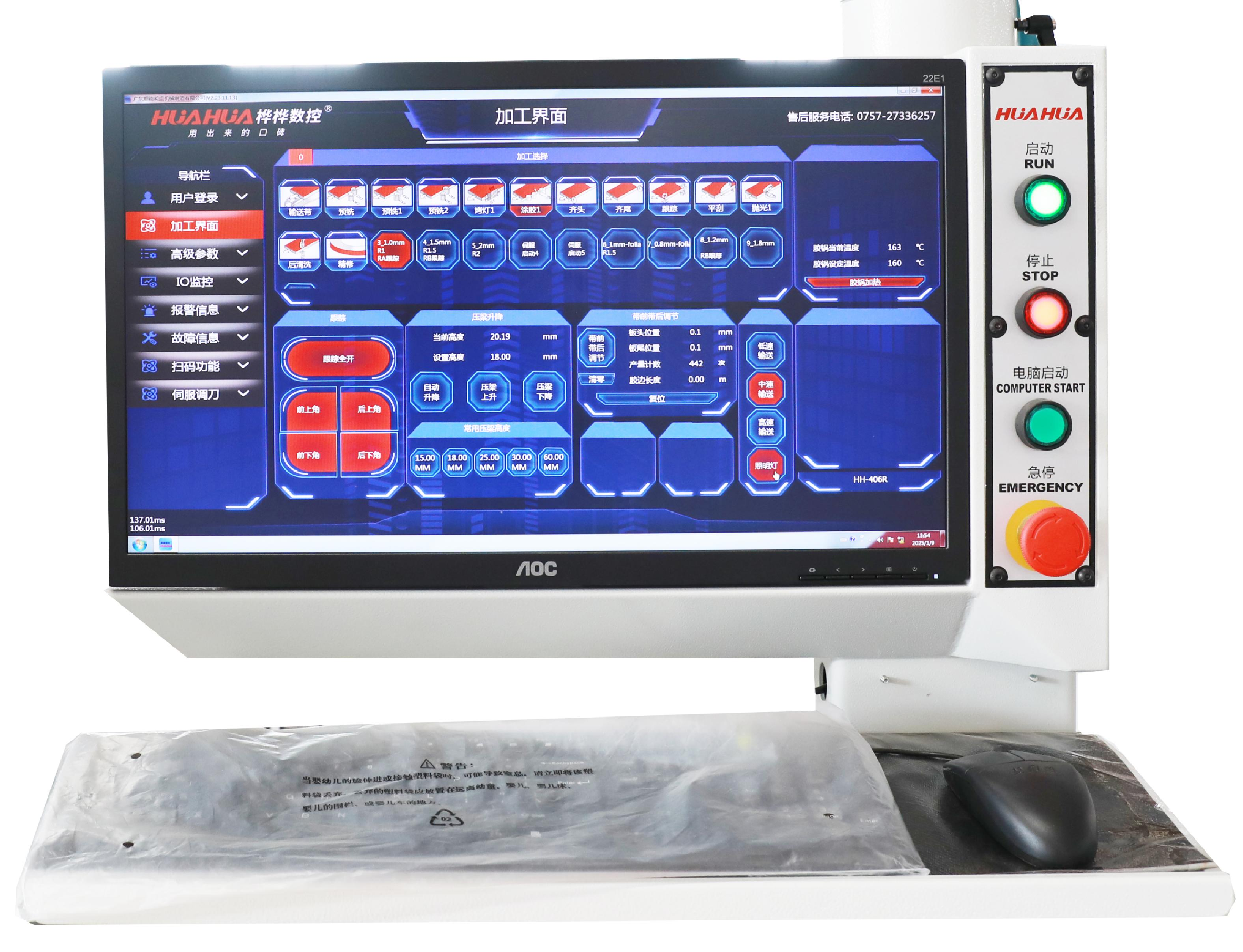
Do not ignore the control interface. Poorly integrated HMI screens and mismatched communication protocols produce stoppages that mimic mechanical failure. Ensure spare parts policy for glue pumps and pressure rollers, and schedule preventive checks for the servo drive and encoder. Maintain a realistic maintenance cadence rather than assuming the vendor warranty will cover operational wear.
Three Golden Rules for Selection and Evaluation
1) Metric: First-pass yield on edge adhesion — target improvement of at least 15 percentage points versus manual—this quantifies defect reduction. 2) Metric: Throughput consistency — measure standard deviation of cycle time per panel; a desirable reduction is 30% or more, which demonstrates stability. 3) Metric: Mean time to repair (MTTR) for adhesive and trimming subsystems — aim to halve MTTR through better parts access and documented procedures. These three rules focus procurement and operations on measurable outcomes rather than promises.
Closing Reflection
When implemented with intention, a local servo edge-banding installation converts intermittent failures into predictable outcomes and allows teams to meet delivery commitments with confidence. For facilities seeking reliable integration and service depth, HUAHUA CNC has shown practical support in aligning machine selection with production constraints — a piece that often completes the conversion from pilot to plantwide deployment. —