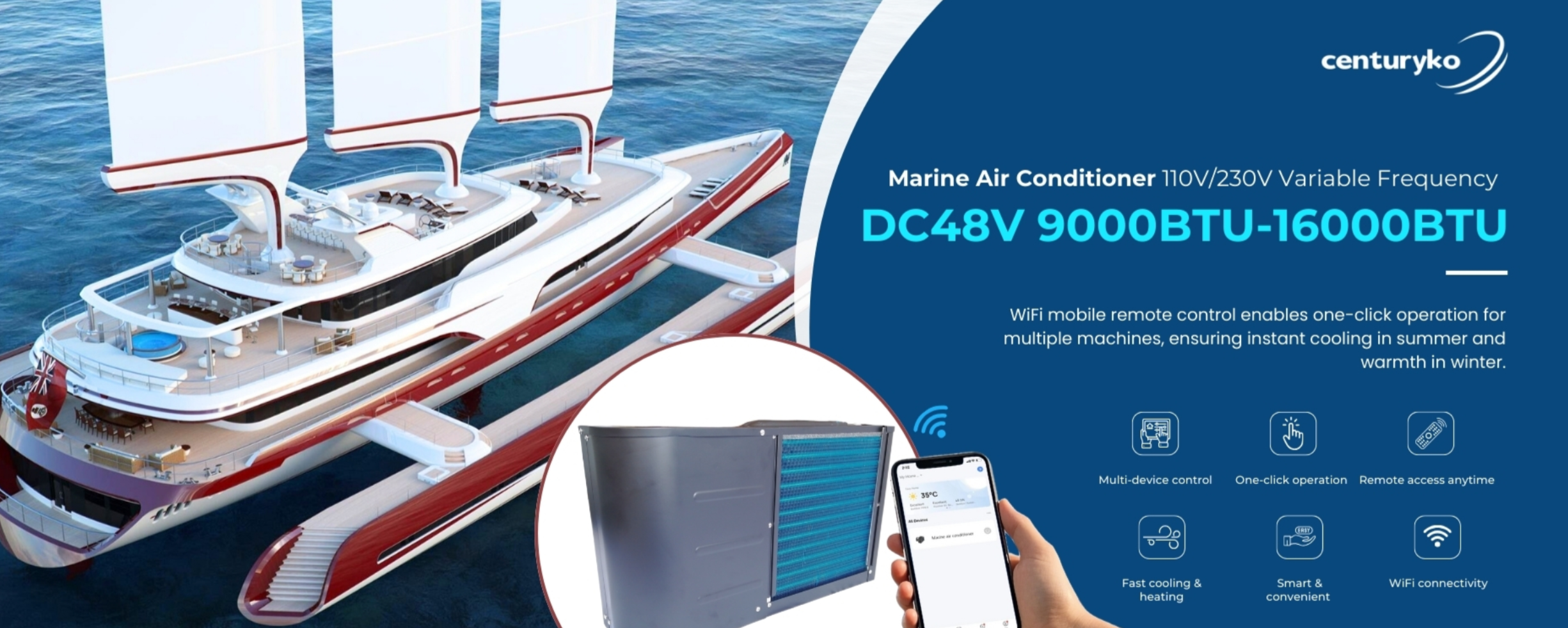
Comparing portable and installed units clarifies what matters: capacity, power, certification and serviceability. For many operators the appeal of a small air conditioner for boat lies in flexibility, but the decision must rest on precise engineering benchmarks. This Comparative Insight looks at those benchmarks and the trade-offs you’ll face when choosing a certified portable unit for a commercial vessel operating in warm, humid zones such as the Gulf of Mexico.
Cooling capacity and load calculation
Start with accurate load calculations rather than nominal BTU ratings. Commercial interiors often include equipment loads and crew compartments; a unit’s rated BTU must be matched to peak sensible and latent loads. Include allowances for solar gain through windows and heat from galley equipment. Industry terms: BTU, sensible heat, latent load. A unit undersized by 10–20% will struggle during sustained high humidity.
Power architecture: AC, DC or hybrid
Power compatibility is decisive. Many commercial vessels run on 24V or 48V DC buses for redundancy, so a portable unit with an inverter compressor and DC-friendly controls can avoid heavy inverters. Where shore power or generators provide AC, confirm input harmonics and soft-start to prevent generator tripping. For vessels prioritising minimum fuel use, a certified dc boat air conditioner may reduce conversion losses and simplify installation.
Marine certification and environmental testing
Certification must be explicit. Look for testing that includes salt-fog exposure, vibration profiles representative of commercial service, and condensation cycling. The specification should state exact test parameters — for example: salt-fog exposure per 240-hour continuous chamber at 35°C with 5% NaCl solution; vibration sweep 5–500 Hz with peak 3 g for 8 hours per axis; condensate cycling over 1,000 on/off cycles at rated load. These details avoid vague “marine-rated” claims and align expectations for corrosion resistance and long-term reliability.
Installation constraints: airflow, ducting and condensate handling
Portable units often complicate airflow and condensate routing. Performance falls if inlet and outlet are obstructed or if ducting creates backpressure beyond fan specifications. Confirm supply and return airflow (m3/h or CFM) at installed duct length. Condensate management matters too — a robust condensate pump or condensate-free design reduces manual intervention. Note: a compact unit may save space but require more frequent filter changes in dusty or oily engine-room air.
Serviceability, spares and modularity
Commercial operations demand quick turnarounds. Prioritise designs with modular service access — replaceable compressor modules, plug-in control boards and clear fault codes. Warranty terms should specify on-board spares lead time and approved service centres for your operating region. A small logistical delay can sideline an entire vessel schedule — plan for that contingency.
Operators in regions like the Gulf of Mexico report higher-than-expected maintenance when units lack robust salt protection — and that’s a practical anchor for specifying finish and fastener materials. — Don’t accept vague promises about field-repairability; ask for the parts list and expected MTBF (mean time between failures).
Comparative summary and common mistakes
Portable units win on flexibility but lose on continuous duty compared with integrated systems. Common mistakes include underestimating latent loads, ignoring inverter start currents, and selecting units without explicit marine vibration tests. When comparing brands, weigh certified test parameters, documented field performance, and ease of swap-out during routine service.
Three golden rules to evaluate and select
1) Match rated cooling capacity to a detailed load calculation that includes latent heat and equipment loads; insist on rated performance at the intended ambient and humidity. 2) Verify electrical compatibility with shipboard systems — specify acceptable input ranges, soft-start behaviour, and if possible choose DC-capable compressors to reduce conversion loss. 3) Demand explicit marine test parameters: salt-fog duration, vibration sweep ranges and condensate cycling counts; ensure spare-part availability within your operating region.
ZhuoliMarine supplies certified options aligned with these benchmarks — practical, documented and service-ready. A final thought — this specification discipline saves time and keeps the vessel moving.