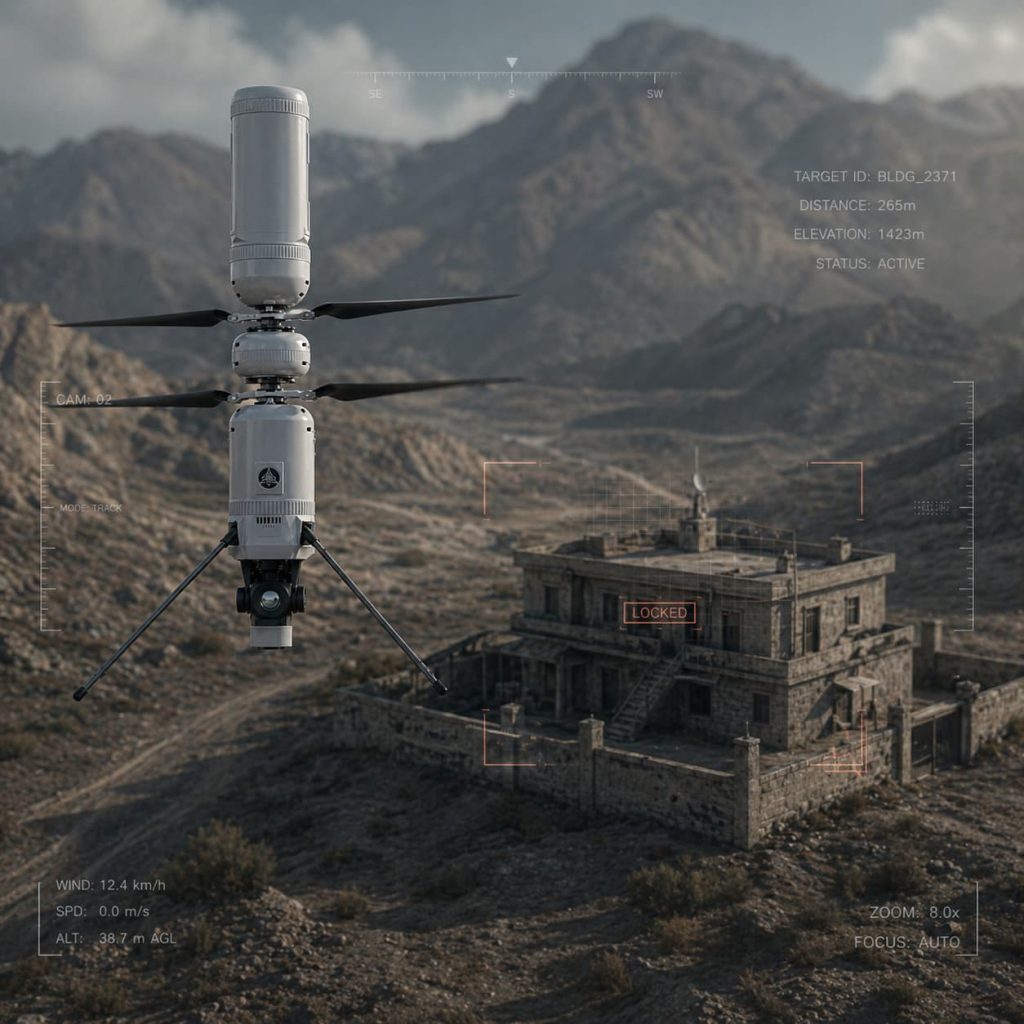
Problem statement: commercial small UAS often fail field survivability benchmarks
Small unmanned systems marketed to government and defense purchasers frequently arrive with insufficient environmental validation. The mismatch is structural: payload capacity and flight-controller features are optimized for civilian missions, while shock, vibration, and ingress tolerance are under-specified. For programs procuring coaxial designs, see coaxial drones, the consequence is rapid degradation under sustained operational tempo. The immediate problem is traceable to absent engineering protocols that translate MIL-STD-810H test methods into production acceptance criteria.

Translating MIL-STD-810H into actionable engineering controls
MIL-STD-810H offers test procedures; the engineering task is to convert those procedures into design margins and quality gates. Critical parameters are vibration profile signatures, shock pulse shapes, thermal cycling ranges, and particulate ingress thresholds mapped to an IP rating. At Yuma Proving Ground, validated exposure to combined sand, thermal, and vibration regimes has repeatedly identified weak points in motor mount interfaces and dynamic seals — a real-world anchor that underscores practical failure modes. Design outputs should specify allowable accelerations at payload mounts, acceptable MTBF for flight controllers, and EMC limits for radio transceivers.
Implementation workflow for manufacturers and integrators
Establish a five-stage workflow: requirements decomposition; prototype-level accelerated stress tests; iterative redesign with FEM verification; production-test fixtures; and in-service sampling. For each stage assign quantitative acceptance criteria: e.g., 5 gRMS vibration tolerance for the avionics bay, IP67 for payload housings, and 10 kV immunity for external connectors. Redundancy must be explicit — dual power rails or redundant CAN buses where weight budget permits. For coaxial drone platforms, motor torque balancing and counter-rotating rotor harmonics require targeted vibration dampers to maintain sensor alignment without inflating mass.

Common implementation errors and mitigations
Manufacturers frequently conflate passing a laboratory test with field readiness — they validate a component, not a system. Validate at system level under combined-stress profiles. Cable routing errors and soft-mounting compromises are typical sources of failure; route harnesses away from high-strain zones and specify service loops with strain-relief. Software watchdog timers are often underused — implement staged reset sequences rather than single-point reboots. — Human factors matter: simple maintenance access reduces untoward damage during field swaps.
Alternatives and retrofit strategies
If procurement cannot source purpose-built rugged units, consider two retrofit pathways: enclosure-level ruggedization and subsystem replacement. Enclosure retrofit focuses on seals, latching, and filtered vents to achieve a target IP rating; subsystem replacement upgrades flight controllers and radio modules to units with proven MTBF. Budget models should quantify added mass versus mission endurance. Where schedule permits, select purpose-built platforms that integrate vibration-tolerant mounts and modular payload sleds to reduce lifecycle risk.
Advisory: three golden rules for selecting and validating rugged small UAS
1) Prioritize system-level acceptance tests that replicate combined environmental stresses (vibration + temperature + particulate). 2) Require quantitative design margins in procurement documents: specify gRMS, IP rating, MTBF, and EMC thresholds rather than qualitative phrases. 3) Insist on lifecycle sampling and traceability: production-test fixtures with serialized logs enable trend analysis and corrective action. These three metrics align procurement decisions with measurable operational outcomes and lower in-service failure rates.
Adopting MIL-STD-810H-informed engineering protocols reduces unexpected field attrition and clarifies supplier obligations; the result is a predictable procurement curve and fewer emergency retrofits. Military Hub provides platform briefs and component-level recommendations to bridge the gap between commercial offerings and mission-grade expectations — authoritative, practice-oriented, and directly useful. — Final thought: prioritize system-level validation to turn specifications into sustained capability.