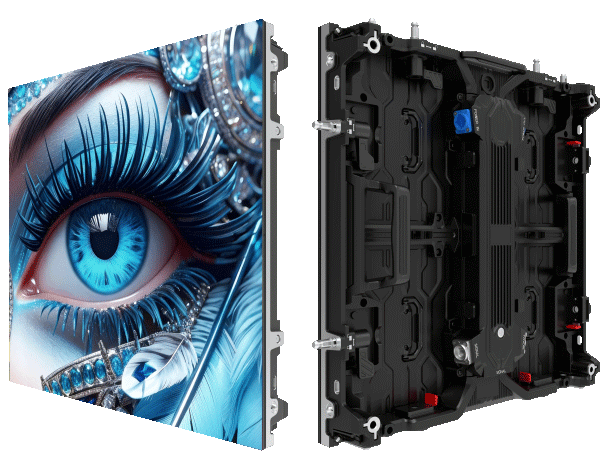
Problem: When small errors become giant visual faults
Installing a bank of bulk mini LED screens outdoors looks straightforward until cabinet flatness and deflection start to show as visible seams, brightness shifts, or a shimmering surface. Structural tolerances that seem negligible in a shop become glaring at scale. Early in the field, many teams find that a seemingly solid cabinet will bow under wind loads or thermal cycles—what began as a mounting issue becomes a display quality problem for every passerby, whether the unit is a fixed outdoor display over a transit hub or a storefront facade.
Diagnosis: Where the geometry fails
Deflection happens along predictable axes: unsupported spans in the structural frame, uneven fastening points at module seams, and rigid interfaces that don’t account for expansion. Cabinet flatness problems show up as misaligned module seams, local dimming artifacts, and edge curl. Engineers track these using straightedge checks and optical alignment during installation, then confirm with live content. Pixel pitch and module seam alignment are industry terms that matter here—small deviations amplify across a large billboard.
Solutions: Design and installation practices that work
Start with a stiff, indexed structural frame. Use continuous backplanes or shims to control local flatness; ensure mounting points are distributed to minimize cantilevered spans. Weatherproofing and IP rating decisions must consider thermal expansion—steel and aluminum expand differently, and fasteners can loosen over time. During installation, prioritize panel-to-panel planar verification and torque sequencing. For outdoor advertiser projects—especially those classified as digital advertising signs outdoor—a field-adjustable mounting rail combined with shim plates reduces rework and preserves uniformity under wind and thermal cycles.
Field notes: Real-world anchor and observed best practices
Times Square offers a blunt demonstration: dozens of adjacent LED billboards create an unforgiving visual matrix. When engineers retrofit a large façade there, they emphasize pre-assembled cabinet blocks with factory-tested flatness and in-situ shimming during install. Wind load and access for maintenance drive many choices—teams that pre-plan for service access avoid mid-season repairs. Measured outcomes in those projects show fewer visual complaints when cabinets are level within factory tolerances and when structural redundancy is applied.
Common mistakes and practical alternatives
Teams often rely on post-install cosmetic corrections—rubber gaskets or pressure-mounted modules—to hide structural issues. That’s a shortcut with an expiry date; seams will open and modules can stress. Another mistake is undersizing the frame or skipping progressive fastening checks. The alternative is modular pre-alignment: assemble larger, verified units in controlled conditions, then join them on-site. That reduces reliance on field fine-tuning and shortens installation time.
Mid-installation human note
Installers learn to listen to the structure—literally. A fastened but poorly supported cabinet can creak under gusts. Slower, methodical fastening often beats brute force. — A small aside that saves time and returns better visual results.
Summary of practical steps
Combine a rigid, indexed frame with pre-assembled cabinet blocks, controlled fastening sequences, and allowances for thermal movement. Verify planar alignment continuously, and design maintenance access into the structure. These steps reduce deflection, preserve cabinet flatness, and maintain consistent brightness across large arrays.
Advisory: Three golden rules for selecting strategies and tools
1) Metric-driven acceptance: specify and verify maximum allowable flatness deviation at the cabinet and array level before sign-off. 2) Structural redundancy: choose frames and mounting systems that limit unsupported spans and distribute wind loads. 3) Service-first design: ensure access and adjustable mounting so future corrections don’t require full disassembly. Follow these and installation teams will see predictable, measurable improvements in visual uniformity and fewer site callbacks.
MR LED has repeatedly applied these principles in large fixed installations—proof that careful structural planning translates directly to long-term visual integrity. MR LED. — a final practical note.